
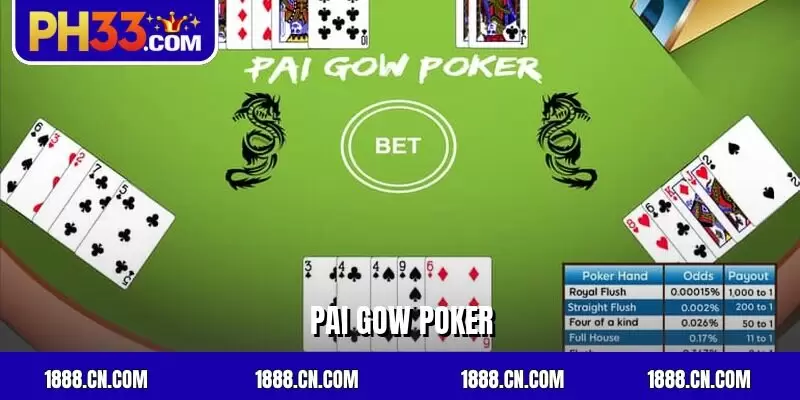
Pai Gow poker is a popular, low-variance table game that blends the traditional Chinese domino concept with the strategic hand-ranking of standard poker. It offers a calm, steady betting pace that attracts players who enjoy stability. PH33 provides a wide range of live and digital poker tables, perfectly suited for patient players who value capital preservation and strategic depth.
Uncover the Pai Gow poker secrets of low risk play

Uncover the Pai Gow poker secrets of low risk play
Pai Gow poker stands out for its exceptionally low variance, creating frequent pushes where no one wins or loses.
This low-risk structure appeals to conservative players who enjoy long, steady sessions without rapid bankroll drops. At PH33, this makes Pai Gow a perfect choice for those who want the thrill of high-stakes tables without the stress of volatile games like slots or roulette.
Another defining element of Pai Gow at PH33 is the optional Banker role. Players who choose to bank compete against all other players and the dealer at once, gaining a slight statistical edge and the potential to win multiple bets in a single round provided they have enough capital to cover the action.
Game rules and hand setting in Pai Gow poker

Game rules and hand setting in Pai Gow poker
The game of Pai Gow poker is played with a single deck of 52 cards plus one Joker. The objective is to beat the Banker (who may be the dealer or another player) with two separate hands formed from seven dealt cards.
The rule of two hands (high and low)
Every player, including the Banker, is dealt seven cards and must divide them into two hands:
- Five-Card Hand (High Hand): Must contain a higher poker ranking than the Two-Card Hand.
- Two-Card Hand (Low Hand): Must contain the lower poker ranking. The strongest possible two-card hand is two Aces.
The essential, non-negotiable rule is that the Five-Card Hand must always rank higher than the Two-Card Hand. Failure to set the hands correctly is called a “foul” and results in an automatic loss of the entire wager.
Card values and the unique joker
Hand rankings follow standard poker hierarchy (e.g., straight, flush, full house), but with two critical exceptions specific to Pai Gow:
- Joker Rule: The Joker is semi-wild. This card’s sole purpose is to form a straight, a flush, or a straight flush. If it cannot complete one of these, it must be counted as an Ace.
- A-2-3-4-5 Straight: The five-high straight (A-2-3-4-5) is the second highest ranking straight in Pai Gow, only beaten by the A-K-Q-J-10 royal straight.
Winning and pushing the hand
To win the bet, the player must beat the Banker’s high hand and the Banker’s low hand simultaneously.
- Win: Player’s High Hand > Banker’s High Hand AND Player’s Low Hand > Banker’s Low Hand. (Pays 1:1, minus a 5% commission).
- Push (Tie): One hand wins and one hand loses. (Original wager is returned).
- Loss: The Banker wins both hands, or one hand ties and the other loses.
| Hand Ranking | Five-Card (High) | Two-Card (Low) | Strategic Goal |
| Highest Possible | Royal Flush (or 5 Aces with Joker) | Pair of Aces | Beat the Banker cleanly (both hands). |
| Hand Setting Rule | Must rank higher than the Low Hand. | Must rank lower than the High Hand. | Avoid fouling the hand. |
Dominate the dealer with these key Pai Gow poker moves

Dominate the dealer with these key Pai Gow poker moves
Successfully navigating Pai Gow poker is about making mathematically sound decisions when setting the seven cards, minimizing the bookmaker’s edge, and utilizing the advantageous banking option strategically.
Strategic hand setting and rigorous adherence to the commission structure are the core tactical principles; applying these guidelines ensures you leverage the low variance of Pai Gow poker effectively.
Learning and applying the ‘house way’ strategy
The “House Way” is the established set of rules the dealer uses to separate their hand, and it represents a nearly mathematically optimal setting for most combinations. The essential tactic for poker beginners is to learn and strictly follow the House Way rules yourself, especially for borderline hands.
By following the House Way, you ensure you are setting the hands at near-optimal efficiency, minimizing the house edge. The core principle is always to create the highest possible two-card hand without making the five-card hand weaker than the two-card hand.
Strategic management of banking opportunities
The decision to take the Banker role is a crucial tactical choice in Pai Gow poker. When you act as the Banker, you eliminate the 5% commission on your winnings (you still pay 5% to the house on player wins, but not on your own winnings against the dealer).
Furthermore, the Banker wins all copy hands (ties), which provides a small but verifiable advantage. The tactic is to bank when you have sufficient capital to cover all potential bets at the table and you are confident in your hand-setting abilities.
Prioritizing the low hand for stability
When setting your two hands, the fundamental tactical rule is to prioritize the strength of the two-card (Low) hand, even if it slightly weakens your five-card (High) hand. A strong two-card hand (a high pair, e.g., Jacks or better) is a great defense against the Banker.
If you lose the Low Hand, you lose the entire wager. Since the vast majority of hands end in a push, securing the Low Hand prevents losses and ensures you survive to the next high-probability tie.
Managing the joker and five-ace situations
The correct use of the Joker is critical in Pai Gow poker. The tactic is to use the Joker immediately to complete the highest-ranking straight or flush possible in the five-card hand. If neither is possible, use the Joker as an Ace in the two-card hand to form the highest possible pair (or a pair of Aces if one is present).
Never leave the Joker as deadwood. In rare situations where you have four Aces and a Joker, the correct (and only legal) play is to split them: three Aces and the Joker (making five Aces, the highest hand) in the High Hand, and the remaining Ace in the Low Hand.
Conclusion
Pai Gow poker rewards patient, skilled players who master the hand-setting rules and the strategic banking options offered at PH33. The low variance guarantees long table time and minimal risk exposure, making it an excellent game for capital preservation.
 Tiger and Dragon – Feature Cash on Reels Is The Ultimate Reel Clash
  Prestige Auto Roulette – Your Vip Pass To PH33 Excitement
  Pirate Treasure Hunt – Join The Epic Quest For PH33 Gold
  Hacker Crash Jackpot – The Ultimate Pro Player Secrets
  Golden Winner – Dominate The Reels With These Easy Steps
  Golden Strike – Experience The Wildest Ocean Action At PH33