
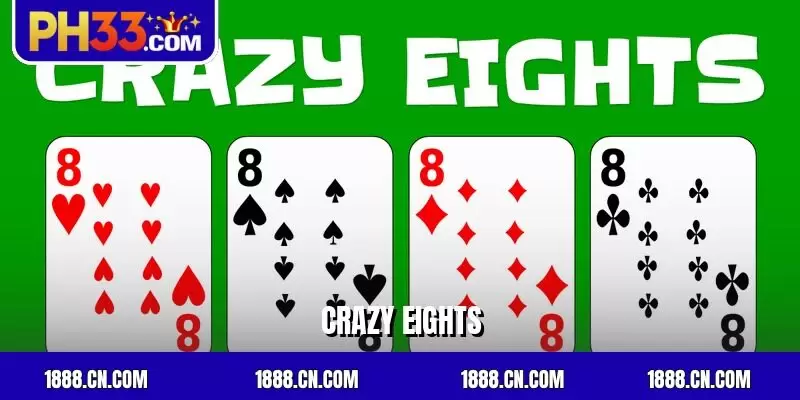
Crazy eights is a highly accessible and fun shedding-type card game, offering rapid action and simple rules that appeal to players of all skill levels at PH33. The core objective is to be the first player to successfully empty their hand by matching rank or suit with the card currently on the discard pile, utilizing the powerful wild ‘8’ cards strategically.
Unlock fascinating facts about crazy eights easy gameplay

Unlock fascinating facts about crazy eights easy gameplay
The appeal of crazy eights comes from its simple rules and fast pace, making it perfect for quick, engaging wagering sessions.
New players can learn the mechanics within minutes, while the strategic choice of when to hold or discard an 8 still challenges experienced players. PH33 brings this title into its card lobby thanks to its high engagement rate and low entry barrier.
Another standout feature of crazy eights is its volatile scoring system. When a player empties their hand, opponents take heavy penalty points based on the value of their remaining cards, especially high-value face cards. This creates dramatic score swings each round, pushing players to constantly adjust their strategy and avoid holding risky deadwood cards.
Master the core rules and secrets of crazy eights
Master the core rules and secrets of crazy eights
Understanding the exact value of the wild 8s and the scoring system is essential before diving into the fast-paced rounds of crazy eights at PH33.
The objective and the basic play
The aim of crazy eights is to empty your hand of all cards before anyone else.
- Matching: Players must match the card on top of the discard pile either by suit (e.g., placing a Heart on a Heart) or by rank (e.g., placing a 7 on a 7).
- Drawing: If a player cannot play a card, they must draw the top card from the face-down Stock Pile until a playable card is found or the Stock Pile is exhausted.
- Winning: The first player to play their last card wins the round immediately.
The wild card rule
The card with the rank of 8 is the wild card, which gives the game its name and its strategic depth.
- Playing an 8: An 8 can be played on any card at any time, regardless of the suit or rank currently showing on the discard pile.
- Changing Suit: When a player plays an 8, they must immediately declare the new suit that the next player must follow (it can be any suit, including the suit of the 8 itself).
The crucial scoring system
The round winner receives zero points, while all losing players receive penalty points based on their unplayed deadwood cards. The game continues until one player reaches a predetermined score (e.g., 100 points), and the player with the lowest score wins the overall tournament.
- Face Cards (K, Q, J): Count 10 points each.
- Number Cards (2-10): Count at face value (e.g., 5 is 5 points).
- Aces: Count 1 point.
- The Wild 8: Counts 50 points if left in hand (the highest penalty).
| Card Rank | Penalty Point Value | Strategic Implication |
| Face Cards (K, Q, J) | 10 points | Must discard early if unconnected. |
| The Wild 8 | 50 points | Must be reserved or played last; highest risk card. |
| Aces (A) | 1 point | Safest card to hold as deadwood. |
Advanced attachment and forced draws
In the online version of game, the speed of play is amplified. Players must execute their turns quickly, and the pressure of the accumulating penalty points forces aggressive shedding. Knowing which cards to hold and which to dump is paramount for long-term score control.
Top strategic blueprint for dominant crazy eights wins
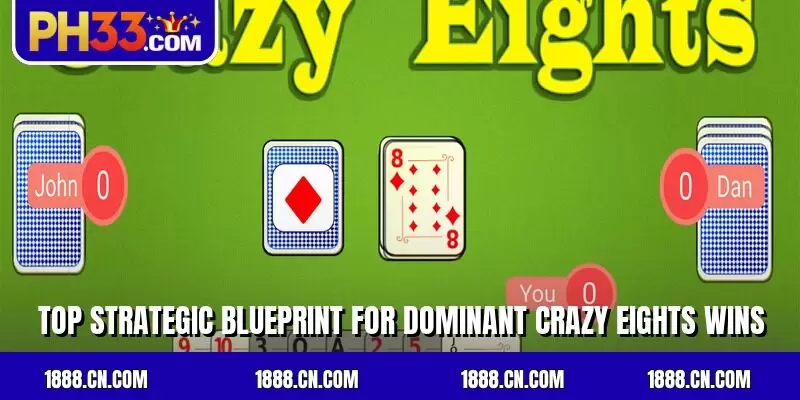
Top strategic blueprint for dominant crazy eights wins
Success in crazy eights is achieved through meticulous score control, disciplined discarding, and the tactical deployment of the wild 8s to manipulate the flow of the game, rather than simply luck of the draw.
Strategic score management and calculated deployment of the wild 8s are the core tactical principles; applying these guidelines ensures you survive the volatility of crazy eights.
These tactics are designed to minimize your personal risk of accumulating high penalty scores and to aggressively force opponents into disadvantageous positions.
Score control and minimizing deadwood
The fundamental tactical objective is survival by minimizing your deadwood score, especially the high-value face cards and the wild 8s. The strategic advice is to discard high-value, unconnected cards (like an isolated Queen or King) early in the round, even if the discarded card might help an opponent.
The financial necessity of reducing a potential 50-point penalty from a held 8 far outweighs the small risk of helping an opponent shed a single card.
Tactical deployment of the wild 8
The 8 is your most powerful asset and should be reserved for two critical scenarios in game:
- To Prevent Drawing: If you have no playable cards and the Stock Pile is thin, use the 8 to avoid drawing a penalty card.
- To Force the Next Player: Use the 8 to change the suit to one you know the next opponent is weak in (based on your observation of their discards), forcing them to draw additional penalty cards and potentially delaying their win.
- To Force the Next Player: Use the 8 to change the suit to one you know the next opponent is weak in (based on your observation of their discards), forcing them to draw additional penalty cards and potentially delaying their win.
- The Last Card: The 8 should only be played as the very last card if you have no other options, as it is a crucial defensive tool.
The discipline of avoiding the attachment trap
Never allow yourself to get down to only one or two cards early in the round unless you are absolutely certain of winning immediately.
The attachment trap occurs when an opponent, realizing you are close to winning, strategically plays a card that forces you to draw from the Stock Pile, delaying your win while they shed their own high-value cards. Maintain at least three cards for defensive flexibility, even if it means holding back a playable card for a turn or two.
Strategic management of high-value deadwood
High-value cards (Tens, Jacks, Queens, Kings) must be managed ruthlessly. The tactical advice is to actively break up low-value sequences (e.g., 2-3-4) to discard the 4, if necessary, while prioritizing the discarding of high-value singles.
Low cards carry minimal penalty risk and are safer to hold as deadwood than high-value cards, which are the true killers in the crazy eights scoring system.
Conclusion
Crazy eights is a fast, fun, and highly tactical shedding game rewarding players who master the dual art of shedding cards quickly and rigorously controlling the final scoring. PH33 provides the perfect competitive environment for this engaging title.
 Tiger and Dragon – Feature Cash on Reels Is The Ultimate Reel Clash
  Prestige Auto Roulette – Your Vip Pass To PH33 Excitement
  Pirate Treasure Hunt – Join The Epic Quest For PH33 Gold
  Hacker Crash Jackpot – The Ultimate Pro Player Secrets
  Golden Winner – Dominate The Reels With These Easy Steps
  Golden Strike – Experience The Wildest Ocean Action At PH33